Content repurposing turns one blog post into social content
By Hoxigen · 23 Oct 2026
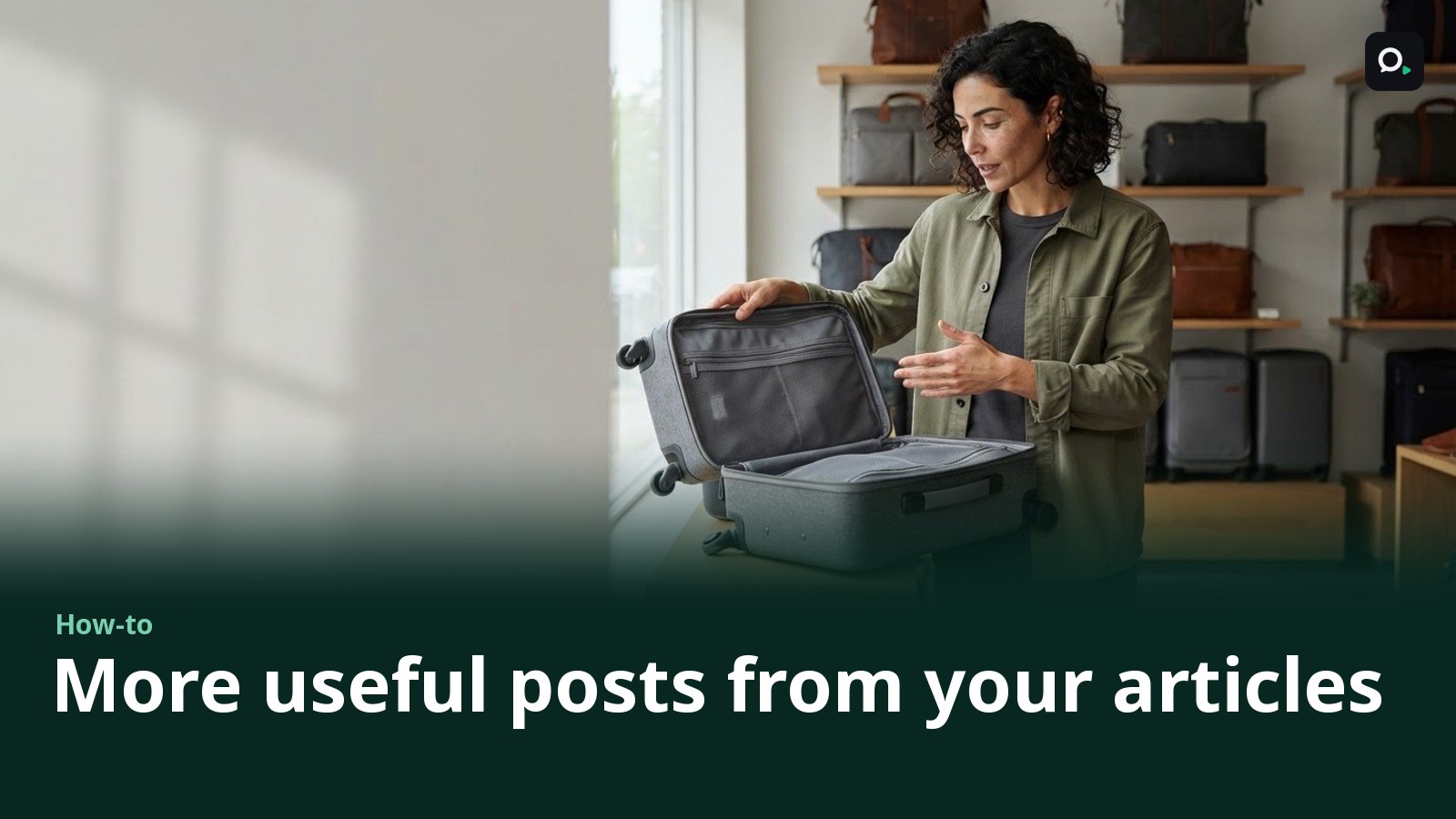
Turn a useful blog article into social posts that answer distinct buyer questions by extracting its advice, examples and decision rules. Content repurposing saves you from researching every post from scratch. The work is choosing what each post should explain, then adapting it to the channel instead of copying the article’s introduction.
Key takeaways
- Choose an article with practical advice and current product facts before turning it into social content.
- Give each social post a separate buyer question, rather than repeating the article’s summary.
- Keep conditions and limitations attached to the claims you reuse.
- Match the format to the explanation: a short answer, a visual sequence or a demonstration.
- Measure social engagement separately from visits and actions on your website.
1. Choose an article that helps a buyer decide
Start with an article that explains a choice your customers actually face. Questions from sales conversations, support messages and search queries make better starting points than a broad company update.
For example, a luggage shop might have an article about choosing carry-on luggage. It can explain how to check an airline’s current allowance, compare an empty bag’s weight and assess whether its compartments suit the trip.
Check that the article still reflects what you sell. Remove discontinued products, outdated policies and unsupported claims before reusing them elsewhere. An error becomes harder to correct once it appears across several channels.
Use the same publish-ready checks you apply to SEO articles to confirm that the source deserves to be reused.
2. Extract answers, examples and limitations
Read the article for reusable ideas, rather than paragraphs to copy. Each idea should make sense to someone who never opens the full article.
Collect these building blocks:
- A buyer question: What uncertainty does this part of the article resolve?
- A direct answer: What should the reader do or understand?
- An example: What real product detail or situation makes the answer concrete?
- A limitation: When would the advice change or need checking?
- A next step: Should the reader compare options, inspect a feature or read the full explanation?
In the luggage example, “check dimensions including wheels and handles” is a useful standalone angle. “Our guide covers everything about travel” gives the reader little to act on.
Keep the airline-specific caveat with the dimensions advice. A shorter post still needs an accurate answer.
3. Give each post a different job
Separate the ideas by the decision they support. Repeating the same summary with different opening lines creates more posts without adding much value.
The carry-on article could become a post about measuring the outside of a bag, another about comparing empty weight, and another about choosing compartments based on what the traveller needs to reach quickly.
Write the main answer before adding a headline or call to action. If the answer needs the entire article to make sense, narrow the question further.
Use a link to the article when readers need its deeper explanation. A post that answers a simple question completely can stand on its own. Avoid making every useful detail conditional on clicking through.

4. Choose the format that makes the answer clear
Adapt the idea to how someone will encounter it. A dense article paragraph rarely works unchanged in a social feed.
- Text post: Explain a decision rule, followed by its reason and an important caveat.
- Carousel: Show a sequence, such as what to inspect when comparing bags, with a distinct point on each slide.
- Short video: Demonstrate a physical detail or explain a comparison that benefits from movement.
- Story: Share a focused detail or reminder that remains useful without the whole article.
Choose photographs that show the feature being discussed. A close view of a wheel assembly helps explain inspection; a generic airport image does not.
Keep product demonstrations honest. Show the actual item, and avoid implying that a visual proves durability, performance or universal suitability.
5. Check the shortened version before scheduling it
Read each draft without looking at the source article. A reader should be able to identify the question, understand the answer and see any condition that affects it.
Check for claims that became broader during editing. “This bag fits this airline’s published allowance” must not become “approved for every flight.” Confirm the current allowance before making even the narrower claim.
Also check links, image relevance and whether the post promises information the linked page actually provides. Schedule the posts around when each idea is relevant, rather than releasing every adaptation together.
For a broader look at reducing the handoffs involved, see how social media automation can cut work beyond scheduling.

6. Automate repeat work while keeping the source accurate
A repeatable brief makes delegation easier: identify the source article, intended buyer, selected question, factual limits and desired format. Keep product facts in the source current so future drafts start from reliable information.
Hoxigen is an AI CMO that plans, writes and publishes articles and social content. Each draft goes through an AI editor, and each connected channel can run on Autopilot or Approve first. Nothing publishes to an unconnected channel.
Those controls help with review and delivery. They do not make an outdated product claim true. Keep business-specific facts accurate, whichever tool or person produces the adaptations.
7. Review the buyer question, not just the post count
Look at engagement for signs that an angle resonated. Where your analytics supports it, check whether social visitors reached the article and took a meaningful action on your site.
Treat those as separate observations. Engagement does not establish sales impact, and a change in website activity does not prove one post caused it.
Keep useful angles, clarify confusing answers and retire advice that no longer fits your offer.
Start a Hoxigen free trial with one current buyer-question article as your reference for reviewing social drafts; the trial lasts 14 days, includes 2,000 credits and requires no card.